
The Shoebox
What the fire did not erase

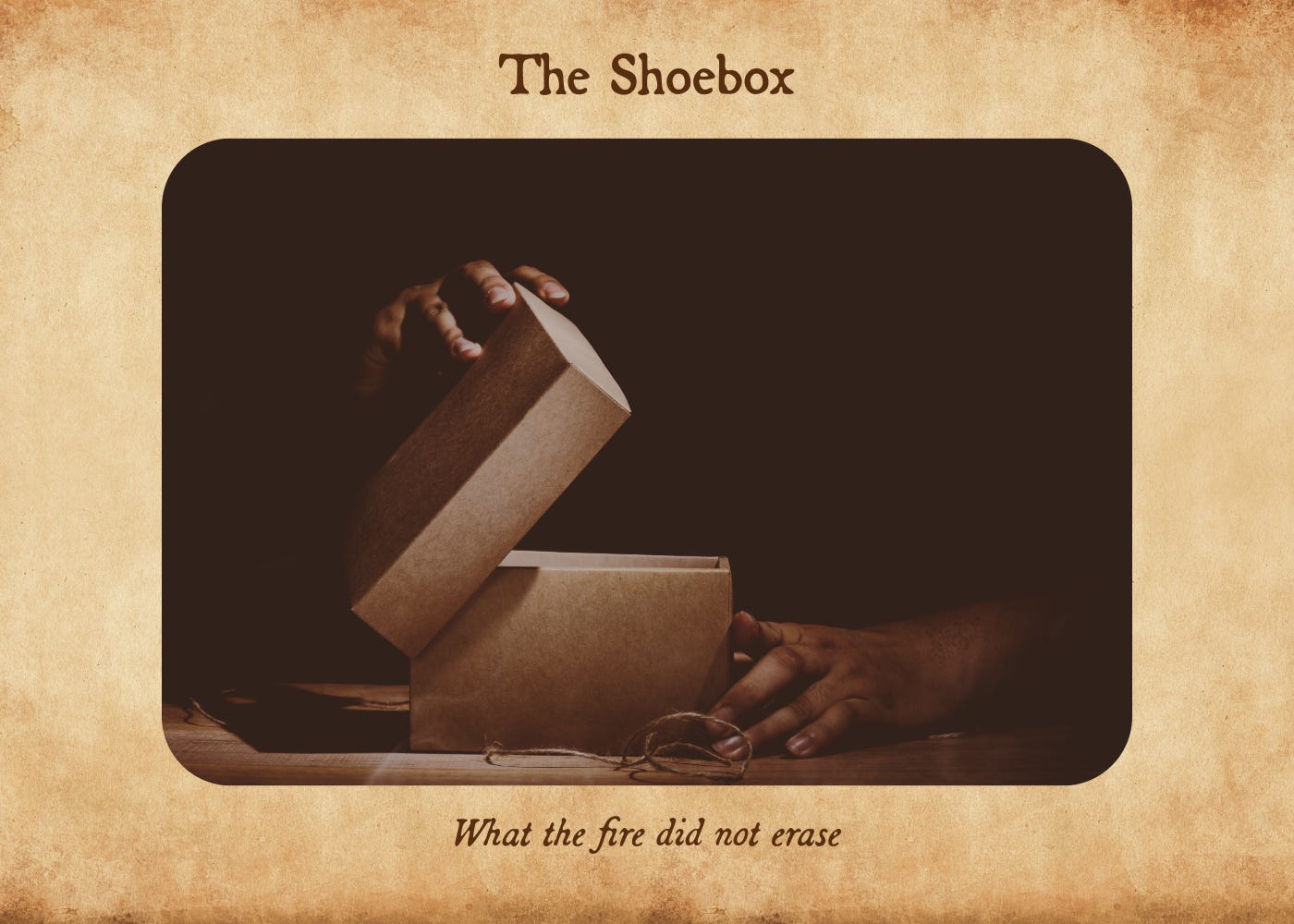
On a Sunday morning in Texas, I was sitting on the couch with a cup of coffee, listening to Fr. Mike, when my daughter told me about the shoebox.
She was a thousand miles away from me, but her voice came through calm and careful, almost too careful, as if she were afraid to hurt me. Or embarrass me.
The truth is, I was embarrassed.
I never wanted my children to know.
She said that years ago she had found a shoebox in my grandmother’s office closet. Inside were police reports from my childhood.
That is all it took. One sentence, and the day shifted.
Or maybe it was not the day. Maybe it was me. All at once I felt outside my own body, as if I were someone else sitting there on that couch, someone else listening to two people speak about a life I had spent years trying not to hand down.
I have only one clear memory of my parents together from before I was five. I was in their bedroom. My mother was sitting on the bed eating, and I was holding a softball bat. I think they were arguing. I remember the feel of being in the room with them, though I could not tell you now what either of them wore, or what the room looked like, or how it ended.
After that, almost nothing.
From that memory until I was nine, I have no memory of my mother at all, and very little of my father. What I remember instead are classrooms, books, my grandparents, and the strange patchwork of a childhood that never stayed still for very long.
I remember the smell of crayons, paper, and pencils. I remember the lunchroom, the playground. I remember the happiness of a desk beside the shelves of books. That small corner of a classroom could feel like the best place in the world. In a life that shifted too often, books and classrooms made a kind of order I could trust.
When my mother came back into my life at nine, she was almost a stranger to me.
The years inside that shoebox were the years when I told and told and told. Those papers came from those years, though I still do not know exactly what was written there. I only know what I lived. I ran away. I begged to be believed. I pleaded with my mother, only to understand later that she had known all along and let it continue. I was useful to her. I was part of what gave her the life she wanted. Not because she wanted me safe. Because I still served a purpose.
I remember telling in so many rooms: living rooms, classrooms, police interview rooms. I remember adults who should have been careful asking questions no child should ever have to answer, and some questions so ugly they seemed to stain the air around them. I told and told and told, and somehow it only made everything harder to bear.
My grandmother did try, in her own way. She went to my father. I remember sitting on his couch while he asked, and I cried. There were police stations and lawyers after that. There were questions, and allusions, and the uneasy shape of truth moving around the adults in my life.
Many adults knew. Knowing, it turns out, is not the same as doing anything meaningful.
My father knew enough too, but not enough to tear apart the life he had made elsewhere. Many adults knew. None were brave enough to do what would have mattered. In the end, my mother stayed with her husband. My father chose his wife. I was the one who had to move. I was the one who had to leave.
When I was fourteen, my mother finally said aloud what may have been the truth all along.
“I never wanted her. I never wanted to be a mother or a wife. I did all of this to hurt you.”
The “her” was me. The “you” was her mother. I understood that much, even then.
The truth escaped her mouth in a moment of rage. It was not spoken to protect me. It was spoken to wound her mother.
I think we were in a room at the county courthouse. I remember my grandmother sitting nearby, looking so hurt she seemed almost emptied out. Maybe she was ashamed too. I remember my father looking lost, as if he had wandered into a life he did not know how to hold. I cannot picture my mother clearly now. I cannot call up her clothes or even her face. But I remember her voice. I remember the words.
And I remember running.
I ran out of the building and into a parking lot, though I had nowhere to go. I remember wondering where I was supposed to live now. Who would want me now. And beneath that, the worse question: what had been done to me that made me feel so ruined in my own skin. That kind of harm leaves behind more than memory. It leaves shame. A dirtiness you did not choose and cannot seem to wash off, no matter how many years pass.
Why would my grandparents want me, when I had already cost them their daughter? I already knew there was no place for me in my father’s new family. And somewhere in me, I had always known my mother never really wanted me. I was a means to an end, the way out of her parents’ house, the tool she used to get the life she wanted.
What she said in that courthouse room was cruel enough to hollow out a life. But those words also ended something. I was sent to my father’s house, where one kind of harm stopped, but welcome did not begin.
After that, I never saw my mother again.
So when my daughter talked about my grandmother’s shoebox on that Sunday morning, I think all of those years rose at once. Not in order. Not neatly. Just all at once, like a room full of people turning to look at me.
She did not tell me everything that was in the box. She only said she found it in my grandmother’s closet years ago and handed it to my oldest child, asking whether they should give it to me. He told her that terrible things had been done to me when I was growing up. Then he brought a barrel near the house, and together they burned the box.
That was about fifteen years ago.
I learned about it only yesterday.
I do not know exactly what was in that box. Maybe there were answers in it. Maybe only a record. Maybe nothing but old reports and terrible language and the flat voice of institutions writing things down and still doing nothing to protect me. I do not know what I would have done with it if it had been placed in my hands. Of course I would have opened it. I probably would have thought I was lifting the lid on something ordinary from my grandmother’s closet, maybe a pair of her old shoes, the sage green ones she loved and wore so often.
Instead, it was a time capsule of harm.
For the most part, I am glad it burned.
No one needs to read police reports about a child. No one needs to see whatever else was in there. I only wish my children had never seen it. I think they burned the box because they did not want me reminded. Or because they did not want me to know it had existed. Maybe they were trying to protect me in the only way they knew how.
But the fire did not erase anything.
That part of my life was never erased. It simply became the part everyone learned not to name. The part people could survive only by pretending it never happened. Me included.
If I was lying, then everyone else got to stay clean.
No one had to ask what they missed. No one had to ask what they suspected. No one had to ask what they permitted, or how long a child can tell the truth before the adults around her turn silence into a shelter for themselves.
And still, there is another truth I have had to live with.
The person who hurt me most was also the one whose words finally broke the arrangement that kept me there.
For years I have wondered what was worse: the evil itself, or the permission that made room for it, the hiding that let it persist, the looking away that kept it fed.
They were not worse. They were the same sin wearing different faces.
Later that day, after the call had ended and the coffee had gone cold, I kept thinking about the box, about paper burning in a barrel somewhere years ago, about my children standing there with a match and a history they should never have had to touch.
I thought about how strange it is that the system once wrote something down and still did nothing with it.
That may be what unsettled me most. Not because the shoebox burned, but because some part of my life had once been written down, hidden away, found by my children, and set on fire before I had the chance to read it for myself.
Not the life itself. Just the record.
The life was never gone.
Others may have known. Others may have tried. But in the end, what remained was not justice, only a box of papers and the silence around them.
Somewhere beyond the fire, the questions are still waiting.